Seamless gutter installation
Professional Seamless Gutter Installation in Greenville, South Carolina
Seamless gutter installation in Greenville starts with measuring your roofline and forming continuous aluminum runs on site, so joints appear only at corners, end caps and outlets. Whether you are replacing worn sectional gutters or outfitting a new roof, the goal is the same: move water off the roof and away from the house without overflow.
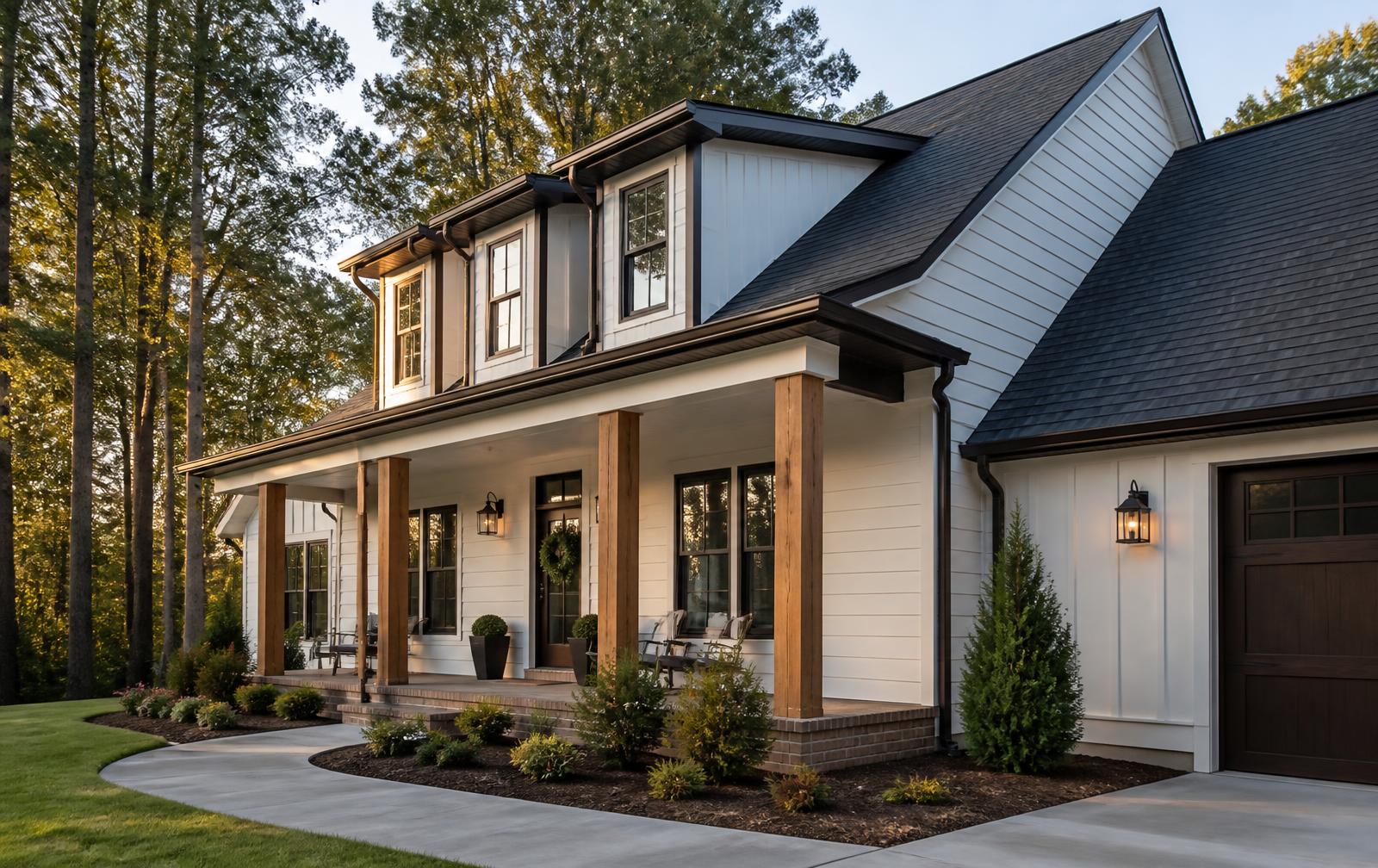
What we install
Seamless aluminum gutters, formed at your property
Seamless gutter runs are roll-formed on site from aluminum coil using a portable forming machine. Because each length is cut to the measured run, a 40-foot side of a house can be a single piece of gutter rather than several sections joined together.
K-style profiles are the most common choice in Greenville neighborhoods — they hold more water than a comparable half-round and their front face reads like crown molding against fascia trim. Half-round and specialty materials such as copper may be available as a premium option depending on supply and the specific project; we confirm what can actually be sourced before quoting it.
Material specifications vary. Aluminum coil is produced in different thicknesses and finishes, and product lines differ between suppliers, so we state the exact material on your written estimate rather than assuming every project uses the same gauge.
Typical project scope
- Full gutter replacement
- New construction gutter installation
- 5-inch and 6-inch K-style systems
- Custom on-site roll forming
- Downspout sizing and routing
- Corner and transition detailing
- Color selection from available coil
- Old gutter removal and disposal
Comparison
Seamless vs. sectional gutters
Both systems move water. The practical differences show up in joints, appearance and how they age.
| Consideration | Seamless gutters | Sectional gutters |
|---|---|---|
| Number of seams | Joints only at corners, end caps and downspout outlets | A joint every 10 feet or so along each run |
| Leak potential | Fewer joints means fewer places separation can start — not leak-proof | More sealed joints, each of which can eventually open up |
| Appearance | Continuous line along the fascia with no visible splices | Visible seams and lap marks along the run |
| Custom sizing | Cut to the measured run at the property | Assembled from stock lengths and fittings |
| Installation | Requires an on-site forming machine and crew | Can be assembled from off-the-shelf parts |
| Maintenance | Fewer joints to inspect; debris still collects | Joints and sealant need periodic checking |
| Repair | Damaged sections usually mean replacing a full run | Individual sections can be swapped out |
Sizing
How gutter size is determined
Gutter capacity is a function of how much water reaches the run and how fast it can leave. That depends on:
- Roof area draining into each gutter run
- Roof pitch, which affects how quickly water arrives
- Local rainfall intensity during heavy Upstate storms
- Roof valleys concentrating several planes into one point
- Downspout size, count and placement
- Overall drainage at ground level
Six-inch gutters with larger downspouts are a good fit for many steep or valley-heavy roofs, but they are not automatically necessary. Plenty of Greenville homes drain well with a properly pitched 5-inch system and an added downspout in the right place.
Process
A typical installation
- 1Inspect the existing roof drainage and gutter system
- 2Measure each gutter run and note corners and transitions
- 3Check fascia condition for soft or rotted board
- 4Determine gutter and downspout sizing for the roof
- 5Roll-form seamless gutter runs on site
- 6Hang gutters with appropriate pitch and hanger spacing
- 7Install and route downspouts and extensions
- 8Check drainage performance where practical
Actual sequence and duration vary by property — access, roof height, fascia repairs and weather all affect the day.
Related
Pairs well with
Many homeowners add leaf protection systems at the same time as new gutters, since the covers are fitted to the new runs. If the fascia behind the old gutters is soft, our soffit and fascia repair work happens before the new system goes up.
We install throughout Greenville County, including Simpsonville gutter installation, Greer and Taylors, and Mauldin and Five Forks. Start on the seamless gutters in Greenville overview if you're still comparing services.
FAQ
Installation questions
Do I need 5-inch or 6-inch seamless gutters?
Sizing follows the roof, not a rule of thumb. Larger roof planes, steep pitches, and valleys that funnel several planes into one run move more water per minute and often justify 6-inch gutters with larger downspouts. Many simpler rooflines drain fine with 5-inch K-style gutters.
What gutter material and thickness do you install?
Aluminum is the most common choice for seamless residential gutters in the Upstate. Material thickness and specific product lines vary by project and by what the installing crew stocks, so we confirm the exact specification with you at the estimate rather than promising a single gauge for every job.
Can you match my trim or roof color?
Aluminum coil is available in a range of factory finishes, and we'll review the options that can be sourced for your project during the estimate. Availability of specialty finishes and materials such as copper or half-round profiles depends on supply at the time of the job.
Do old gutters have to come off first?
Yes. Existing gutters are removed and hauled away, which also exposes the fascia so any soft or rotted board can be addressed before new gutters are hung.
Get a seamless gutter estimate
Tell us about your roofline and drainage concerns and we'll follow up to schedule an on-site look at your property.